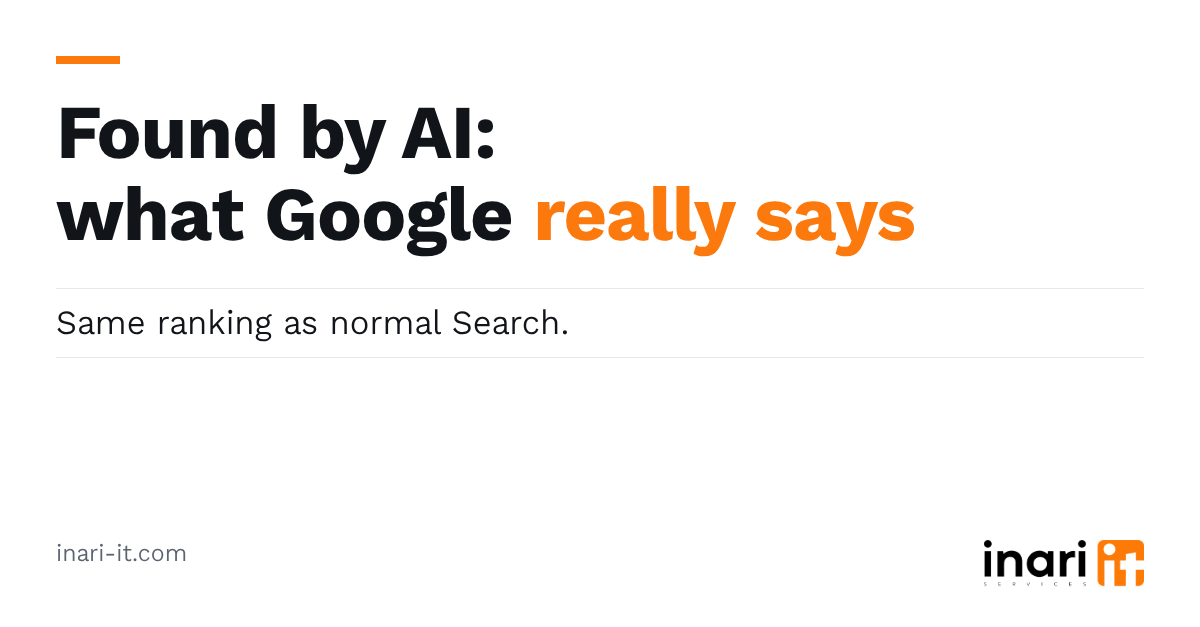
Short answer: The same way as on Google. Google says that optimising for its AI search features is still SEO: AI Overviews and AI Mode use the normal Search ranking systems. Tricks such as an llms.txt file or special AI markup are not needed for Google. What helps is what always helped: a site Google can read, an up-to-date Business Profile, and content only you can write.
What is being sold
Being found by AI is the new question for every business. In Phnom Penh, owners are starting to hear new words: “AI SEO”, “GEO”, “AEO”. The pitch: your customers now ask an AI, so you need a special package to appear in its answers.
The package may include an llms.txt file, “AI markup”, pages rewritten into short blocks, dozens of new pages, or paid mentions on other websites. Before you pay, read what Google itself says.
What Google actually says
In July 2026, Google updated its guide on its generative AI features in Search, AI Overviews and AI Mode. Google describes AEO (answer engine optimization) and GEO (generative engine optimization) as work on visibility in AI search, and its view is simple: this is optimising for Search, and therefore “still SEO”. These AI features are rooted in Google’s core Search ranking and quality systems.
The requirements are the normal ones. A page must be indexed and eligible to be shown in Search with a snippet. Google’s page on AI features says it plainly: “There are no additional requirements to appear in AI Overviews or AI Mode”. Google also warns against tools that promise ranking success: no outside tool has access to its ranking or AI systems.
Four things you do not need to pay for
- An llms.txt file or special “AI markup”. Google Search does not use these files. They do no harm, but they do not help in Google. Other AI services may read them.
- Cutting your content into small pieces. Google says it can understand a page that covers several topics, and that there is no ideal page length.
- Rewriting your texts “for AI”. Google says its AI systems understand synonyms and meaning.
- Buying mentions on other websites. Google says inauthentic mentions are less helpful than they seem.
One thing to avoid: a page for every variation of a question. Google says doing this mainly to manipulate rankings or AI answers breaks its scaled content abuse spam policy.
Structured data is not required for AI search, says Google, but it still helps a page qualify for rich results. Keep it if your site has it; do not buy it as an “AI” product.
What really works for a local business
We have worked on IT and ERP projects in Europe and Asia for 40 years. The lesson repeats: the basics are not exciting, and most of the value is in them. A typical situation in Phnom Penh: the price list is a photo, the opening hours are in an old Facebook post, and the Google profile shows a previous phone number. No AI package fixes that. These four steps do.
- Keep your Google Business Profile up to date. Google names it among the details that help local services show in AI answers. Check hours, phone, address, category and photos, and answer reviews.
- Have a website Google can read. Pages Google can crawl, fast on a phone, with important information in text, not only in images or a PDF.
- Write what only you can write. Google says unique, useful content matters most in the long run; content based on common knowledge adds little. Explain how you really work, answer the questions customers ask you in Khmer and English, show your own work.
- Look at Search Console before you buy anything. It is free. Its Generative AI performance report shows how your content appears in Google’s AI features in Search and Discover.
Google does not say on these two pages in which countries or languages its AI features are available. The good news: the advice above is the same as for normal Search, so it pays off either way.
Before you sign an “AI SEO” contract
Ask the seller three questions. Which of these tasks does Google say it needs? How will we measure the result in Search Console? What stays if I stop paying? If the answers are about llms.txt, short blocks or hundreds of new pages, keep your money for your content and your Business Profile.
Besides INARI ERP, INARI IT Services offers web services in Cambodia, hosting included. The first consultation is free: we look with you at your Business Profile, your website and your Search Console, and we tell you what is worth doing. Contact us on our contact page, by email at sales@inari-it.com or by phone at +855 16 733 661.
Frequently asked questions
Do I need an llms.txt file for Google?
No. Google says it does not use llms.txt or other new machine-readable files for Search. Adding one does not harm or help your visibility in Google Search. Other AI services may use it.
Is structured data required to appear in AI Overviews?
No. Google says structured data is not required for its AI features and there is no special markup to add. It still helps a page qualify for rich results in Search.
Should I create a page for every way customers ask a question?
No. Google says that creating content for every query variation, mainly to manipulate rankings or AI answers, breaks its scaled content abuse spam policy. A high number of pages does not make a site better.
How can I see if my site appears in Google’s AI features?
Use Google Search Console. It is free. Google says its Generative AI performance report shows how your content performs in its AI features in Search and Discover.
Sources: Google Search Central, Optimizing your website for generative AI features on Google Search (updated 10 July 2026) and AI features and your website (updated 10 December 2025).